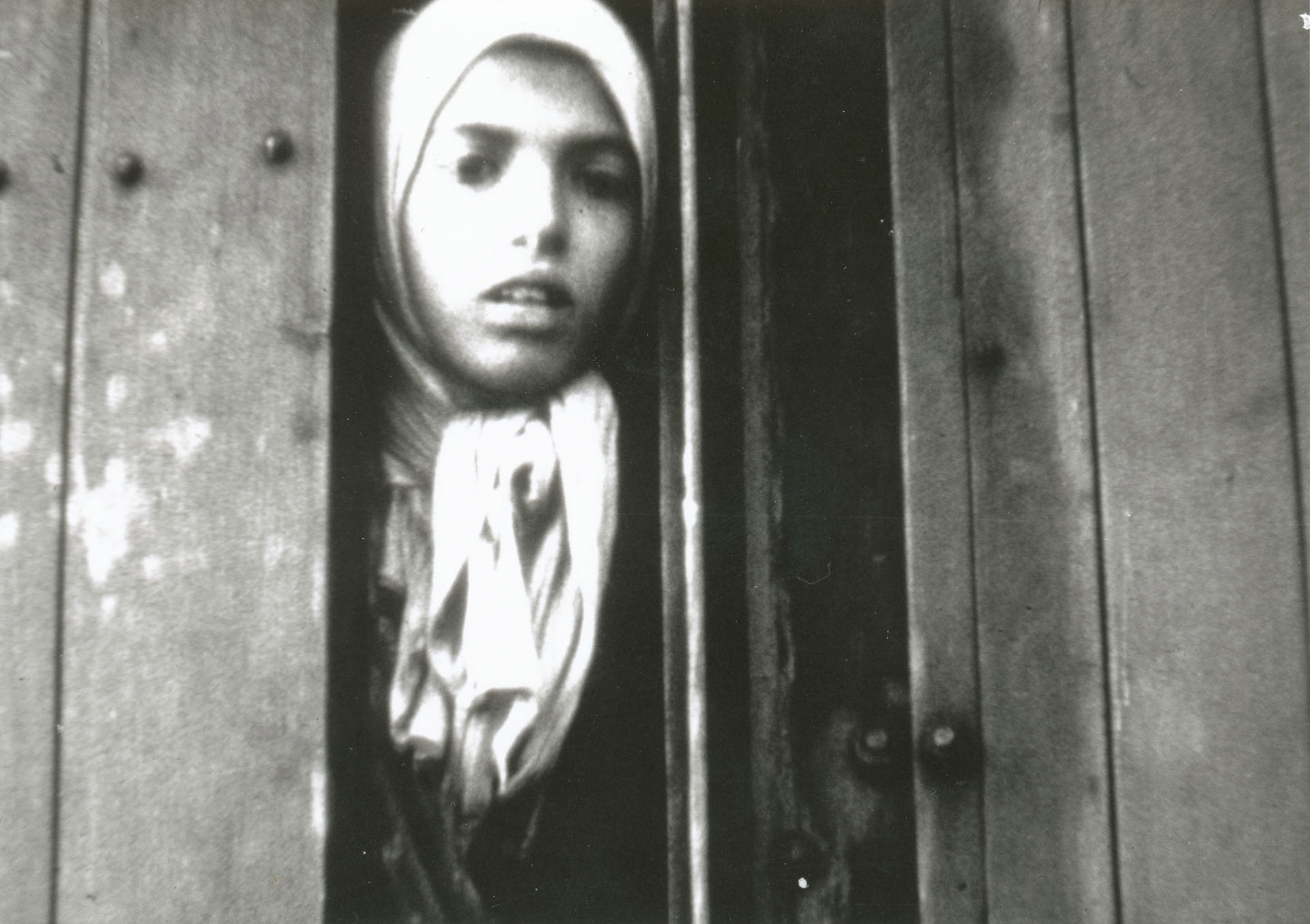
"The girl with the headscarf," Settela Steinbach, looks out through the doors of the carriage. (Image: Westerbork Camp Memorial Center, 1944)
Freedom Path
5 – Anna Maria (Settela) Steinbach
When the transport at Westerbork is ready to depart, the girl cautiously pokes her head out between the doors of the freight car. At the camp commander's behest, Jewish prisoner Rudolf Breslauer is filming the transport that day. The girl's curiosity is piqued by the camera, and Breslauer catches her eye in his film. "Get away from that door, you'll get your head stuck in it," her mother calls, and the girl disappears back into the car. Shortly after, the train departs for Poland.
5 – Anna Maria (Settela) Steinbach
Get away from that door, or you'll get your head stuck in it
80 years of freedom
White headscarf
Breslauer's film footage emerges just after the Second World War. The image of the Jewish girl cautiously poking her head out of the train stands out. For seven seconds, she is seen peering out. She is young, wearing a white headscarf, but no one knows her name. Her portrait is used many times, and over the years, she acquires the title: "The Girl with the Headscarf." Journalist Aad Wagenaar also encounters the image. He is intrigued by the girl and decides to launch a search for her true identity. Wagenaar examines the carriage number visible in the film and discovers that, contrary to popular belief, it is not a carriage carrying Jews. The girl is one of the 245 Sinti and Roma deported from Westerbork to Auschwitz on May 19th. For years, the image of the unknown girl has lived on as an icon of the persecution of the Dutch Jews.
Born under the caravan
Her name is Settela Anna Maria Steinbach. She was born under a caravan on December 23, 1934, in Buchten, South Limburg. Her father was a merchant and a violinist at fairs and village festivals. On May 16, 1944, she was arrested in Eindhoven and had her head shaved in Westerbork transit camp. She was ashamed of this, so she wore a white headscarf. Settela died in Auschwitz at the age of only nine, unaware that she would live on in a remarkable way.
Settela makes us realize that besides Jews, Gypsies were also persecuted during the Second World War.
On May 14, 1944, the Dutch police received an order from Germany: "[…] a central arrest of all persons residing in the Netherlands who bear the characteristics of Gypsies." The nationwide roundup took place on May 16, and more than 550 Sinti and Roma were arrested. Not everyone met the criteria for Gypsyism, and they escaped deportation. Ultimately, 245 Gypsies were deported. Settela's mother, two farmers, two sisters, an aunt, two nephews, and a niece were also part of this group. They did not survive. Settela's father died shortly after the war. It is unclear how many Gypsies were persecuted in Europe. Estimates range from 200,000 to 1.5 million.