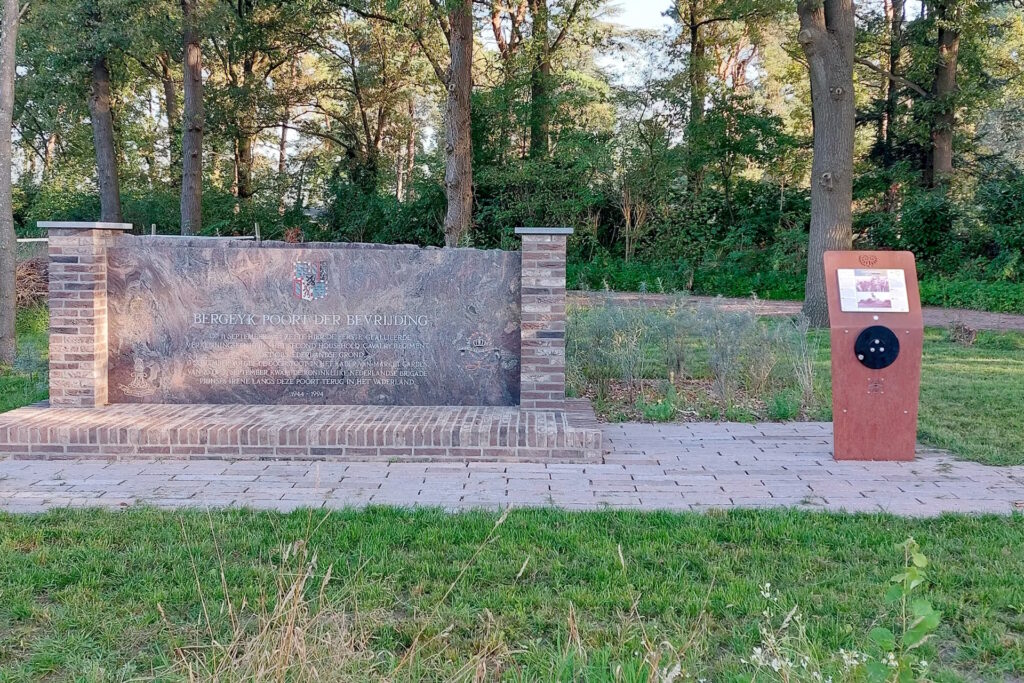
On September 11, 1944, British reconnaissance vehicles entered the Netherlands for the first time. They crossed the border at the Barrier. This made Bergeijk the first municipality in the Netherlands where Allied troops set foot on Dutch soil.
3 – Jef Theuws
80 years of freedom
Jef's risky journey: Between English scouts and German dangers
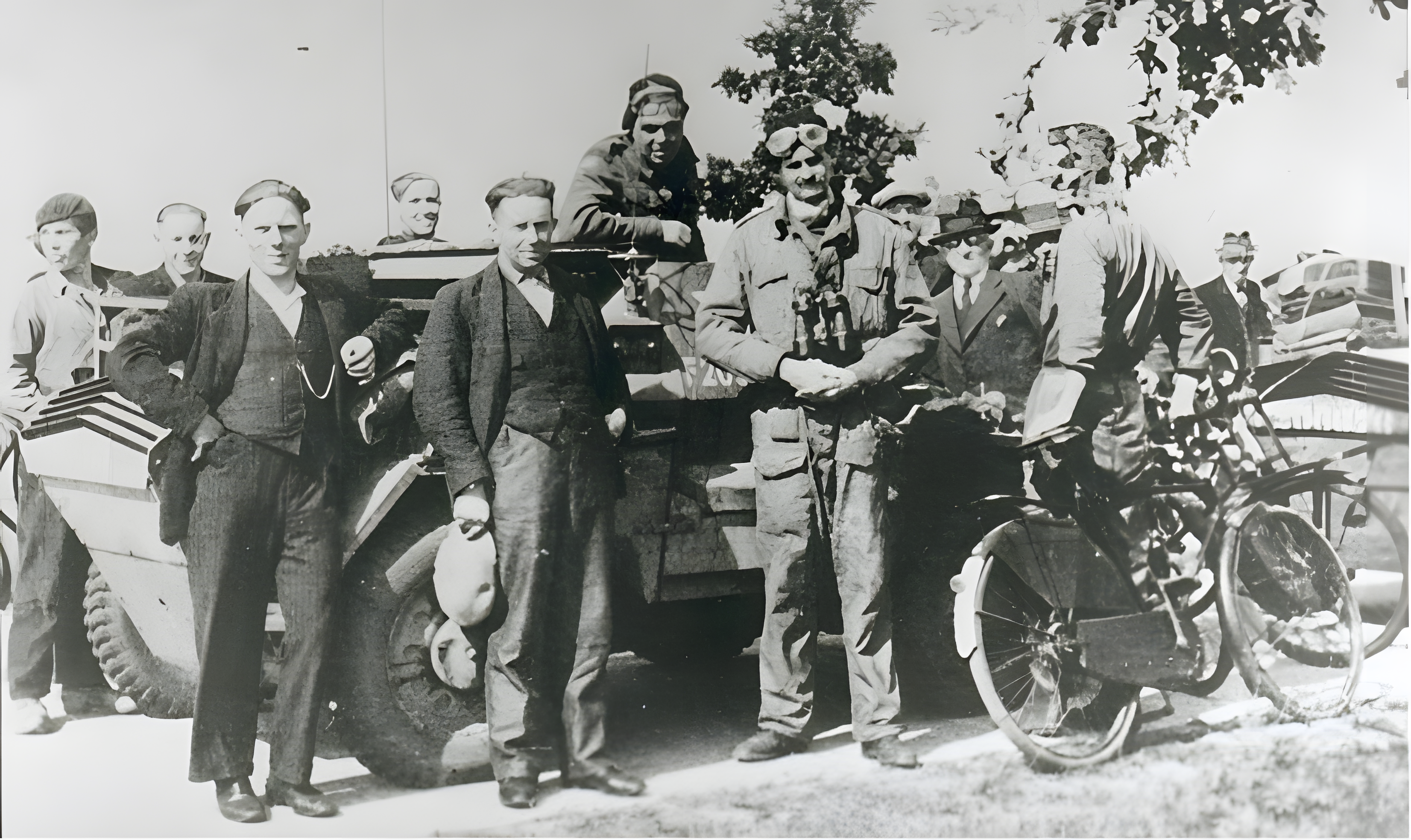
Jef Theuws heard from his mother that there were English soldiers at the Barrier. He decided to cycle there. At the border post on the Dutch side of the border, he heard that there were English soldiers on the Belgian side and that there were Germans in the Liskes. Around 2:10 PM, two English reconnaissance vehicles crossed the border. The English scouts asked if there were any Germans in the area. Since Jef was the only one who spoke English, he explained where the Germans were. Using a military map, he also indicated the precise location of the English. This was where the Gate of Liberation now stands, near the gas station at the Barrier. The English continued on to Borkel and Schaft, and Jef went along to translate. In Borkel, a police officer told him where the Germans were on the Malpie, and Jef translated for the English. The pastor of Borkel and Schaft took a few photos of the group, and the English continued on to Café Van Steenbergen (now: the Suyckerbuyck). Jef decided to cycle back home. When he was almost at the Maaij, a grenade exploded in the middle of the road. The Germans and the British exchanged fire. Jef dove into the ditch, bike and all. Fearing the Germans would recognize him as the one who had pointed out the Germans' positions on the map, Jef decided to flee, bike and all, across the ditch towards Valkenswaard.
Gate of Liberation
Tragedy at the Border: An Unforgettable Photo and the Deadly Shooting
The reconnaissance vehicles were still at Café Van Steenbergen. Jef told the British what had happened. They then contacted the British at the border via a signaling device. It then turned out that two civilians had been killed by the Germans. The flag that had been hung at Café Van Steenbergen had to be removed, the music had to be stopped, and the people had to leave. The British quickly drove back to the border. Later, it turned out that the civilians who had died belonged to the group Jef had posed for. That group, along with the priest from Borkel and Schaft, was on its way to the border. When they were suddenly fired upon, they dove into a ditch. The Germans pulled four people from the ditch near Hofmanheideweg and wanted to execute them. However, one German pleaded for them and let them go. When they were about 50 meters further, on the sandy path towards the Plateaux, they were finally shot from behind. Two of them did not survive. Their bodies were not found until ten days later. The Germans hadn't found the pastor's camera. During the search, he stood with his arms spread out, and the camera hung in the sleeve of his cassock. That's why the photo of the first contact was preserved.