
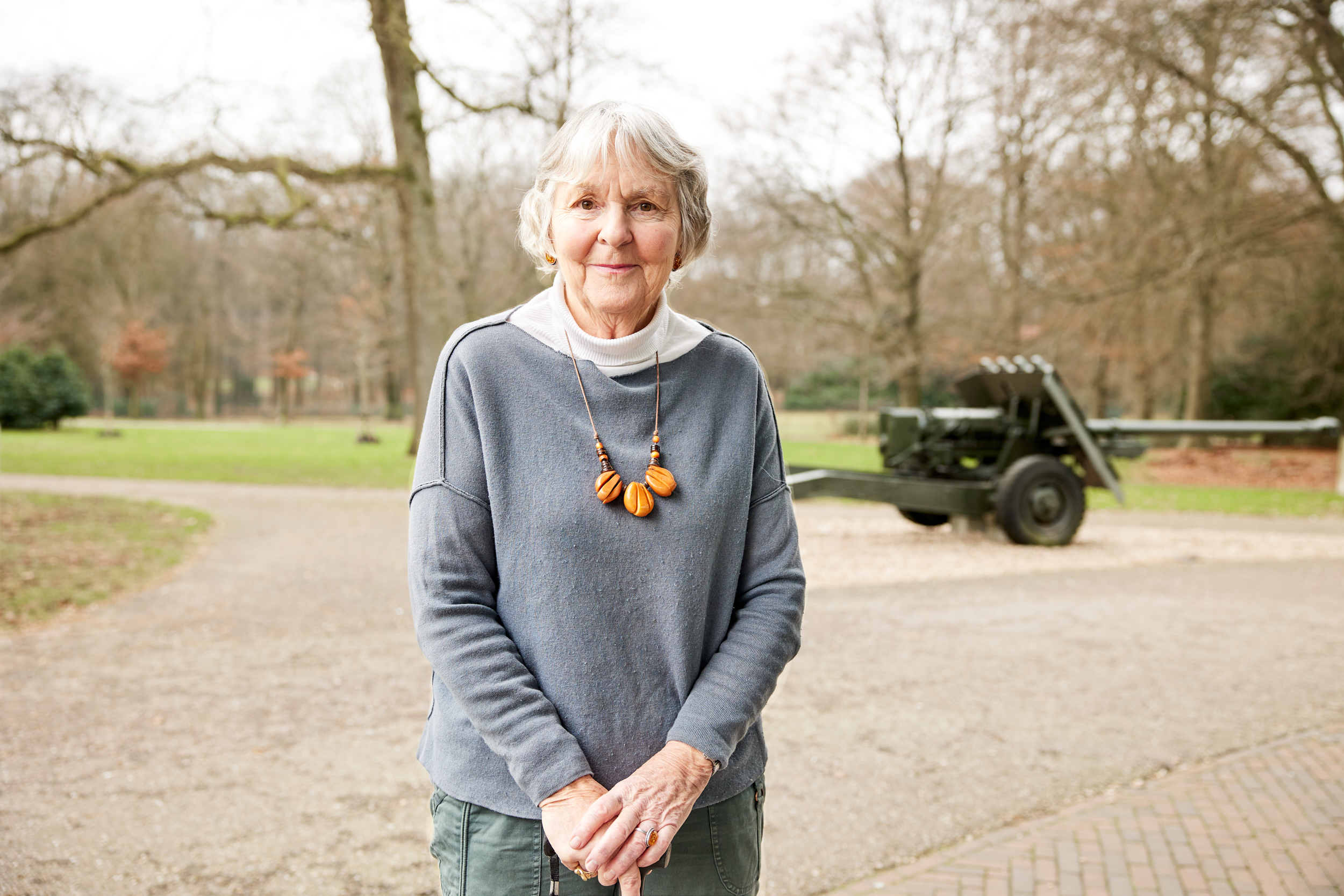
I don't remember a family with a father and mother. During the evacuation, I saw him once at a small hotel in Lunteren. I only remember him bringing delicious eel. My mother didn't go with me; I think she had already decided she didn't want to be with a man who worked for the Germans
The evacuation
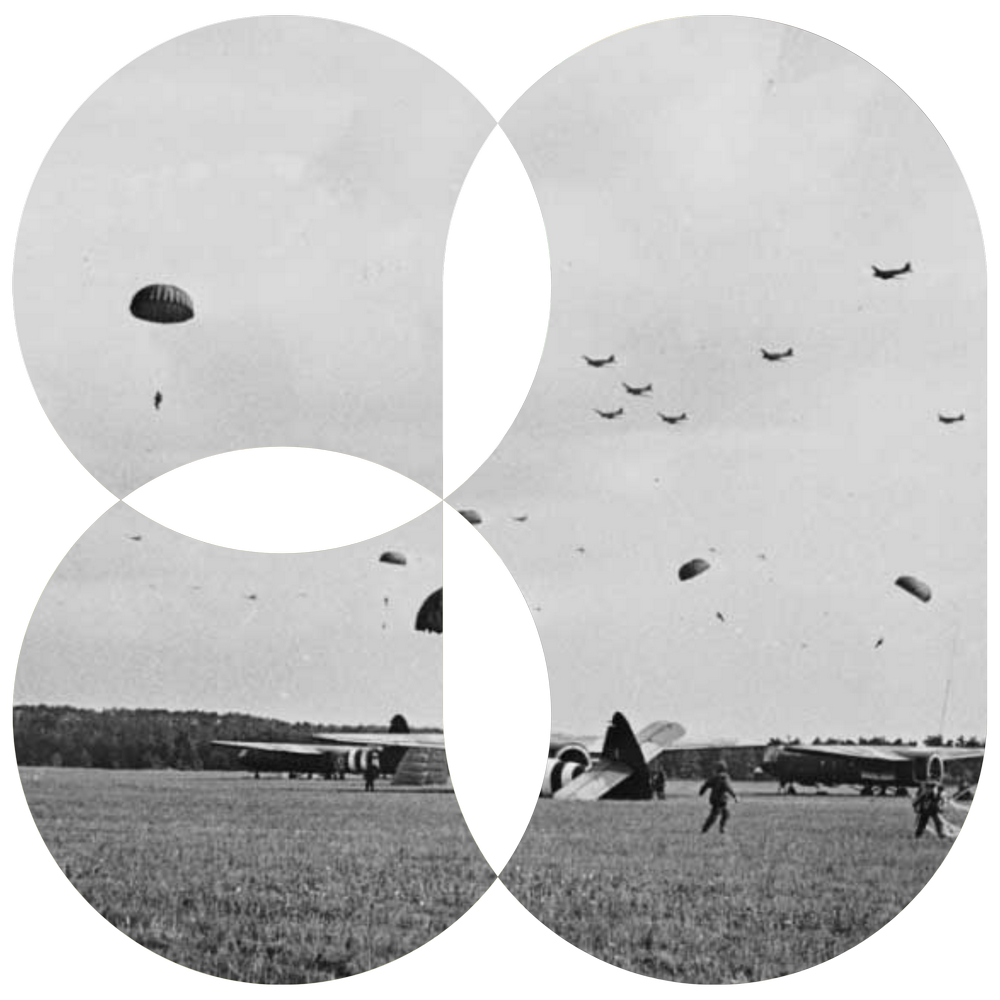
Kiek was only four years old when, in her words, the "magnificent" airborne landings took place. "I saw all these colorful parachutes." Not much later, they marched in a convoy to Schaarsbergen, where the family spent their first night sleeping in straw. "Outside in the backyard, German soldiers were peeling potatoes." While the potatoes were splashing in the water, the soldiers handed out chocolate to the curious Kiek, who had come to watch with her sister. "Mother called us in. We weren't allowed to talk to the Germans. Of course, we didn't understand that at all!"
They couldn't stay in Schaarsbergen, so the journey continued. I walked across the Ginkelse Heide with my eldest brother. Every now and then he'd pull me down into a foxhole. English planes on their way to the Ruhr area dropped bombs. In Ede, the family, along with their neighbors from Arnhem and their two teenage children, were able to stay overnight. "Not longer, because there was no room for us."
The Netherlands was divided into good and bad, and we were wrong. On the way to school, children sang: "Dirty NSB children, we're not allowed to play with you.".
Lunteren
An estate in Lunteren became their long-term residence. A house with 40 other evacuees, "along with my mother, brothers, sister, and teenage children, we slept on the floor." During the day, Kiek and her sister gathered wood. "When we got cold, we went to the barn; it was nice and warm there among the cows. There was an old stable hand, Fluit, who had tiny piggy eyes, I remember. He gave us chicken corn. We'd happily gobble that down."
When flags were raised everywhere on April 16th, it was Kiek's birthday. "We'd spent the morning in the bomb shelter. Fellow residents had made presents: a little green doll set and a painting." Outside, the song "In Holland staat een huis" (In Holland stands a house) played, and everyone gathered in the forecourt. "So much joy and dancing people; we danced around the flagpole."
While the Netherlands was liberated, a difficult time began for Kiek. "If you were wrong, you were really, really wrong. And that's what we were." The house in Arnhem was uninhabitable, bombed, and looted. Finding a new place to live was a struggle for Kiek's mother, because the wife of someone who had chosen the wrong side was not popular. "Finally, my mother managed to find a house in Lunteren."
The family was poor. "The things we still had had been confiscated. Except for a sewing kit from my mother." Kiek's father was arrested immediately in 1945. She didn't see him until 1948. "Whether the government or my mother didn't allow it, I don't know." She always lied when children asked about her father. "At first, I said, 'He's in a camp.' I didn't know what a camp was. They didn't ask me anything more about it."
Kiek's first memory of him after the war is a trauma that still deeply affects him. "I remember a very cold, drafty station where we were waiting for a train. The vague image of a man in a raincoat picking me up and giving me a kiss, just like that!"
A shared fate
“Now that I am 82, I finally dare to tell: my father was on the wrong side during the war.” Neither parent ever talked about their past. “You share that fate with so many descendants of the war. And that hurts.” Images of fleeing children from Ukraine today hit Kiek hard. “Then I think: that is how my mother walked there too. Not knowing where she was going.”